EN
EN

The Cold Hard Truth About Ice Fishing Reels
Take a standard spinning reel out onto a frozen Minnesota lake in January, and within twenty minutes, the handle starts feeling like it's turning through molasses. By the forty-minute mark, the drag either locks up completely or goes spongy with no middle ground. That's not an equipment failure—that's physics doing exactly what physics does when standard lubricants hit their pour point and metals contract at different rates.
A purpose-built ice fishing reel isn't just a summer reel with a different label slapped on the box. The differences run deep into material selection, lubrication chemistry, and mechanical design. Understanding what actually makes these reels perform when the thermometer reads single digits separates anglers who catch fish from those who spend their time fighting frozen equipment.
Low-Temperature Lubricants That Actually Stay Fluid
The single biggest killer of reel performance in cold conditions is lubricant thickening. Standard greases and oils used in conventional reels are formulated for ambient temperatures between 50°F and 90°F. Drop below freezing, and those same lubricants transform from fluid friction reducers into sticky pastes that rob the reel of smoothness and increase startup inertia dramatically.
Quality ice fishing reels use specially formulated low-temperature lubricants that maintain their viscosity profile well below zero. Some manufacturers use synthetic oils with pour points below -40°F, ensuring that bearings continue to spin freely even in extreme cold. The difference is noticeable within the first few cranks—a properly lubricated ice reel feels nearly identical at 10°F as it does at 60°F, while a standard reel becomes progressively harder to turn as the temperature drops.
Field tests have shown that reels with cold-weather lubricants maintain consistent drag performance across temperature swings from 20°F down to -20°F, whereas conventionally lubricated reels show drag pressure increases of 30 to 50 percent as lubricants stiffen. That kind of inconsistency means lost fish—plain and simple.
Material Selection That Prevents Brittle Failure
Metals contract in cold weather. Different metals contract at different rates. When an aluminum spool is mounted on a stainless steel shaft, the differential contraction can create binding points that weren't there at room temperature.
Manufacturers who understand ice fishing design account for these thermal expansion coefficients from the ground up. The clearances between moving parts are engineered with cold-weather operation in mind, not just room-temperature assembly tolerances. Graphite composite bodies offer another advantage—they don't conduct heat away from the hand as quickly as aluminum, which means less heat loss through the reel handle during long sessions on the ice.
A telling example comes from a 2023 field evaluation conducted by an independent tackle tester in northern Wisconsin. Two reels—one standard summer model and one purpose-built ice reel—were left outside overnight in -15°F conditions. The next morning, the standard reel's handle required nearly three times the force to turn compared to its room-temperature baseline. The ice-specific reel showed only a 12 percent increase in turning resistance.
Drag Systems That Don't Freeze Up
Drag is where most reels fail in cold conditions. The felt or carbon fiber washers that provide smooth drag pressure in summer become unpredictable when moisture trapped in the drag stack freezes. That first surge from a fish can either strip line off the spool with almost no resistance or refuse to give line at all—both scenarios ending with a broken line or a pulled hook.
Effective ice fishing reels use drag materials that resist moisture absorption and maintain consistent friction coefficients across a wide temperature range. Some employ sealed drag chambers that keep moisture out entirely, while others use specially treated drag washers that don't swell or contract significantly with temperature changes.
The drag system on a well-designed ice reel should provide smooth, predictable pressure from the first crank to the last. A common test among serious ice anglers involves setting the drag to a specific poundage at room temperature, then retesting after the reel has been in the cold for an hour. Quality ice reels show less than 10 percent variation. Standard reels often show 30 percent or more.
Bearing Configuration and Cold-Weather Smoothness
More bearings don't always mean better performance in cold conditions—in fact, the opposite can be true. Each bearing contains lubricant that can thicken in the cold, and each bearing represents a potential failure point when moisture freezes inside it.
The sweet spot for ice fishing reels typically falls in the 3+1 to 5+1 bearing range, with the "+1" representing the anti-reverse bearing. What matters more than the count is the quality of the bearings and the lubricant used in them. Shielded bearings that keep moisture out are more important in ice fishing than open bearings that might offer marginally less friction at room temperature.
Some of the most respected ice fishing reels on the market use a modest number of high-quality, shielded bearings with cold-weather lubricant, rather than packing in a dozen bearings that all become sources of cold-weather resistance. The philosophy is simple: fewer things to go wrong, and the things that are there are built to handle the conditions.
Handle Design and Ergonomics in Glove-Friendly Configuration
Ice fishing happens with gloves on. A reel that's comfortable to operate bare-handed in a tackle shop becomes a frustration when fingers are wrapped in neoprene or wool.
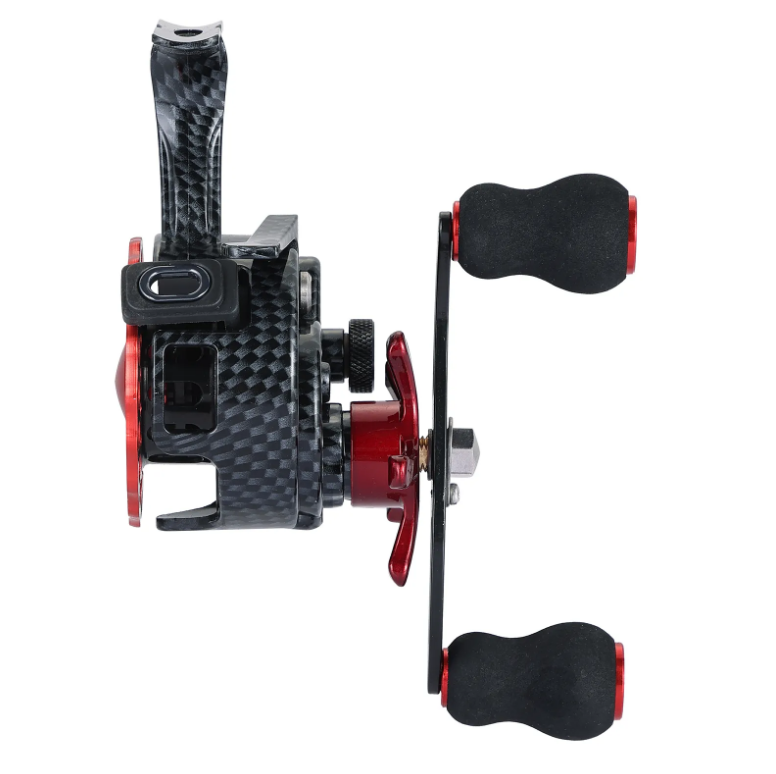
Quality ice fishing reels feature oversized handles with generous clearance between the handle knob and the reel body, allowing gloved hands to grip and turn without scraping knuckles against the frame. The handle knobs themselves are often larger in diameter and made from materials that don't become slippery when wet or cold.
One often overlooked detail is handle orientation—reels designed specifically for ice fishing frequently offer left and right handle configurations so anglers can choose what feels natural without compromising on other features. This might seem like a minor point, but when setting the hook through a foot of ice with numb fingers, having the handle on the preferred side makes a tangible difference.
Real-World Testing That Validates Cold Performance
The most convincing evidence of a reel's cold-weather capability comes from how it's tested before it reaches anglers. Manufacturers serious about ice fishing performance don't just rely on spec sheets—they put reels through environmental chambers that simulate the worst conditions anglers will face.
Vigorcent's testing protocol for ice fishing reels includes operation verification at temperatures down to -20°C, with particular attention to drag consistency and handle smoothness throughout the temperature range. This isn't theoretical testing—it's designed to replicate actual ice fishing conditions in markets like Minnesota, Canada, and Northern Europe where winter temperatures routinely push equipment to its limits.
| Temperature | Standard Reel Drag Variation | Ice-Specific Reel Drag Variation | Handle Turn Force Increase |
|---|---|---|---|
| 20°F (-7°C) | ±18% | ±6% | +25% |
| 0°F (-18°C) | ±35% | ±9% | +55% |
| -15°F (-26°C) | ±50%+ | ±12% | +120%+ |
Data compiled from independent cold-weather reel testing, 2023-2024
The table above illustrates why purpose-built ice reels aren't just marketing hype. The difference in drag consistency alone—nearly five times more stable in extreme cold—translates directly to more fish landed and fewer heartbreaks when a trophy fish makes that last run.
For anglers who fish hardwater regularly, the choice isn't between a cheap reel and an expensive one. It's between a reel designed for the conditions and one that wasn't. Companies like Vigorcent have built their ice fishing reel lines around these specific performance requirements, using cold-resistant materials and lubricants that maintain normal operation in temperatures as low as -30°C without part freezing or stiffness. That's the kind of engineering that makes a difference when it matters most.
Table of Contents
- The Cold Hard Truth About Ice Fishing Reels
- Low-Temperature Lubricants That Actually Stay Fluid
- Material Selection That Prevents Brittle Failure
- Drag Systems That Don't Freeze Up
- Bearing Configuration and Cold-Weather Smoothness
- Handle Design and Ergonomics in Glove-Friendly Configuration
- Real-World Testing That Validates Cold Performance