EN
EN

Why Bass Anglers Keep Coming Back to Low-Profile Baitcasters
Bass fishing has a way of separating gear that works from gear that merely exists. The low-profile baitcasting reel has earned its place in the bass angler's arsenal not because it looks sleek, but because it delivers where it counts: casting accuracy, control, and the ability to handle a wide range of presentations. Walk the bank of any bass tournament and count the number of low-profile baitcasters on the deck. They are everywhere for a reason.
The key features of a low-profile baitcasting reel for bass fishing are not just about specs on a box. They are about how the reel performs in hand, how it responds to thumb pressure on the spool, and how it holds up after a season of hard fishing. Understanding those features separates a reel that gets used from one that gathers dust.
Ergonomic Design and Palming Comfort
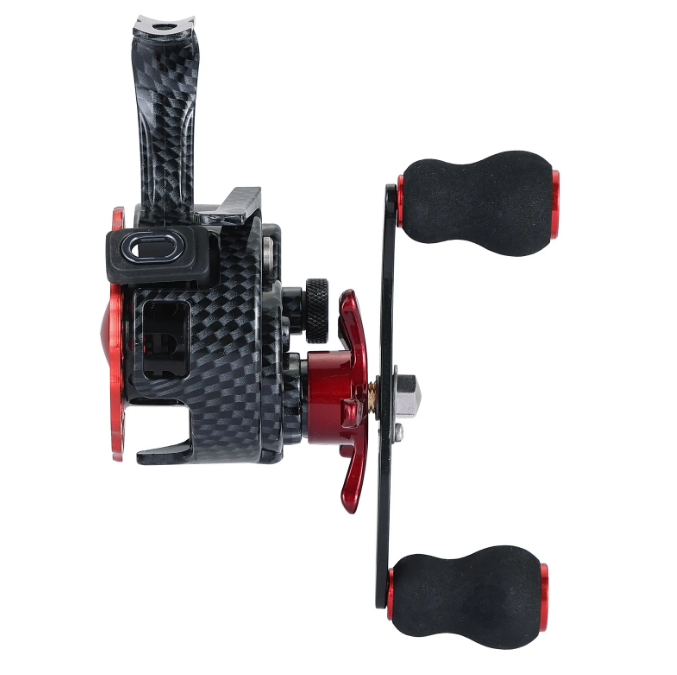
The defining characteristic of a low-profile baitcasting reel is its shape. Unlike round baitcasters that sit high above the rod, low-profile reels nestle down into the angler's palm. That lower center of gravity changes everything. The rod and reel become an extension of the hand rather than a top-heavy lever that fights every cast.
For bass fishing, where anglers make hundreds of casts in a single day, that ergonomic advantage is not just comfort—it is endurance. A reel that palms comfortably reduces hand fatigue, which means better thumb control on the spool during the cast and more consistent hooksets when a fish bites.
The weight matters too. Modern low-profile baitcasting reels often incorporate carbon fiber frames and side plates to shed ounces without sacrificing strength. A 6.7-ounce reel might not sound dramatically different from an 8-ounce reel, but over a full day of pitching and flipping, that difference accumulates.
Gear Ratio and Retrieve Speed
Gear ratio is one of those numbers that gets thrown around in every reel discussion, but for bass fishing, it actually means something. A lower gear ratio—say 5.2:1 or 5.5:1—provides more torque for cranking deep-diving crankbaits or pulling fish out of heavy cover. A higher ratio—7.1:1 or even 8.1:1—retrieves line faster, which is ideal for topwater lures, spinnerbaits, and situations where picking up slack quickly matters.
The right gear ratio depends on the technique. Many bass anglers carry multiple reels with different ratios, but a single low-profile baitcaster with a mid-range ratio—around 6.4:1 to 7.1:1—covers a surprising amount of ground. It is fast enough for most moving baits and torquey enough for moderate cranking.
Braking Systems and Backlash Control
Backlash—the dreaded birdsnest—is the single biggest reason some anglers avoid baitcasting reels altogether. A good low-profile baitcasting reel addresses this with a sophisticated braking system that controls spool speed during the cast.
Magnetic braking systems use magnets positioned near the spool to create resistance as the spool spins. The faster the spool turns, the more resistance the magnets generate. It is a self-regulating system that works well for a wide range of lure weights. Centrifugal braking, on the other hand, uses small brake shoes that engage at the beginning of the cast and gradually disengage as spool speed decreases.
Many modern low-profile reels combine both systems or offer externally adjustable magnetic brakes that let anglers dial in the perfect setting for each lure. The ability to adjust braking on the fly—without opening the reel—is a feature that separates good reels from great ones.
| Feature | Entry-Level Low-Profile | Performance Low-Profile |
|---|---|---|
| Frame material | Graphite composite | Carbon fiber or aluminum |
| Braking system | Basic magnetic or centrifugal | Dual or externally adjustable |
| Bearings | 4+1 | 9+1 or more |
| Drag material | Felt washers | Carbon fiber |
| Spool design | Standard | Shallow, low-inertia |
Spool Design and Casting Performance
The spool is where the casting magic happens. Low-profile baitcasting reels for bass fishing often feature shallow spools designed for the line weights that bass anglers typically use—10 to 20-pound test. A shallow spool reduces the overall mass that needs to start spinning at the beginning of the cast. Less mass means less inertia, which means the spool accelerates faster with less effort.
Some performance reels take this further with U-shaped spools or lightweight aluminum designs that shed every possible gram of rotating weight. The result is longer casts with lighter lures—a critical advantage when finesse presentations call for weightless soft plastics or small jigs.
Line capacity also matters. A spool that holds 100 yards of 12-pound mono is plenty for most bass fishing scenarios. More capacity is not always better—it adds weight and inertia. The right spool holds enough line for the fight without being overbuilt.
Drag System Smoothness and Power
Bass are not known for long, blistering runs like tuna or tarpon, but they do make sudden, powerful surges—especially around cover. A drag system that sticks or chatters during those surges is a liability. Carbon fiber drag washers have become the standard on quality low-profile baitcasters because they provide smooth, consistent pressure without the sudden grab that felt washers can exhibit.
The drag range matters too. A reel with 20 pounds of max drag might sound like overkill for bass, but that reserve power matters when fishing heavy cover where the only way to turn a fish is with direct pressure. The key is not the max number—it is how smoothly the drag delivers that pressure across the entire range.
A Quick Word on Build Quality and Durability
Bass fishing is hard on gear. Reels get dunked, dropped in sand, and subjected to temperature swings from morning chill to afternoon heat. A low-profile baitcasting reel that holds up to that abuse requires quality bearings, corrosion-resistant finishes, and precision machining throughout.
Manufacturing standards matter here. Reels that undergo load testing, corrosion testing, and durability testing before they ship have a track record of lasting longer on the water. The difference between a reel that feels smooth out of the box and one that stays smooth after a hundred fishing trips comes down to those quality control processes.
The Bottom Line on Low-Profile Baitcasters for Bass
The key features of a low-profile baitcasting reel for bass fishing boil down to comfort, control, and consistency. A reel that palms well, casts accurately, and delivers smooth drag pressure makes every aspect of bass fishing easier—from pitching a jig under a dock to cranking a spinnerbait across a flat.
Reels manufactured through facilities like WILDWOLF, with over 20 years of production experience, incorporate these features as standard rather than as upgrades. For bass anglers looking to upgrade their gear, understanding these features is the first step toward a reel that performs as well on the hundredth cast as it does on the first.
Table of Contents
- Why Bass Anglers Keep Coming Back to Low-Profile Baitcasters
- Ergonomic Design and Palming Comfort
- Gear Ratio and Retrieve Speed
- Braking Systems and Backlash Control
- Spool Design and Casting Performance
- Drag System Smoothness and Power
- A Quick Word on Build Quality and Durability
- The Bottom Line on Low-Profile Baitcasters for Bass